what would a gladiator do to prevent his death
It is certainly no secret that the picture show and television set manufacture absolutely loves gladiators. In fact, the motion-picture show Gladiator from 2000, directed by Ridley Scott and starring Russell Crow, has been widely credited with rekindling popular involvement in the classical world in the twenty-get-go century. Unfortunately, almost everything Hollywood thinks information technology knows about gladiatorial combat is really wrong.
Misconception #1: Gladiators were always forced to fight each other to the expiry.
It is true that gladiators fought each other in the arena for popular amusement, only information technology is not truthful that they ever fought to the decease. In fact, for most of Roman history, nether nigh circumstances, information technology was really illegal for a gladiator to impale his opponent and the Romans went to slap-up lengths to preclude fatalities. Nosotros have no way of knowing exactly how many gladiators were killed in the arena, but information technology was probably a much lower number than many people today take been led to believe.
You see, opposite to what most people seem to believe, there were actually rules to gladiatorial combat and there were even referees to enforce those rules. For case, gladiators were not allowed to strike their opponents when they were down and, if they did, they faced repercussions. Usually, a gladiator match concluded when one of the gladiators submitted to his opponent, ane of the gladiators was injured, or when they just became likewise tired to continue fighting and decided to call it a day.
ABOVE: Roman mosaic from the villa at Nenning, dating to the second or tertiary century Advertizement, showing a retiarius fighting a secutor in gladiatorial combat.
The reason for this is considering gladiators were extremely expensive to purchase, train, and maintain. Only the nigh physically fit slaves could even be considered to get gladiators and, once they were gladiators, they required regular workout routines, abiding attention, grooming, and mentoring. They fifty-fifty had professional coaches known as lanista whose job was to fix them for battle. Gladiator-owners e'er wanted a render on all that investment, then they expected their gladiators to survive to compete in every bit many fights as possible. Basically, if you were a gladiator-possessor and one-half your gladiators were killed after their first fight, that would have been a massive loss on your investment. You really, really did not want that.
There was also the problem of demand. Past the early on first century Advert, there was already vastly more demand for gladiator fights than there were gladiators available. As I mentioned earlier, slaves who were fit to become gladiators were difficult to come by and there was a limited supply. If every fight ended in a death, then the Romans would take chop-chop run out of gladiators. This would have been especially true in later centuries, as gladiator fights became more common and more extravagant. Thus, information technology only fabricated sense for them to endeavor to make the gladiators they did have last as long as possible.
Granted, some gladiators did die in the arena occasionally, but these deaths were nowhere near equally common as popular civilisation usually makes them out to be. As I discuss in this article I have written, modern novels, films, tv set shows, and video games have a trend to profoundly exaggerate the level of violence that was common in the ancient globe. The ancient world was still a pretty fierce identify by gimmicky standards, but people generally didn't but go effectually killing each other indiscriminately without reason.
Historians estimate that probably only effectually i tenth of gladiatorial games actually resulted in a single decease. When gladiators did die in the loonshit, it was normally every bit the result of an blow or his opponent adulterous and breaking the rule against killing. While emperors or sure other powerful figures could legally order gladiators to fight to the death, these orders generally seem to have been rare and they were, in almost cases, widely frowned upon.
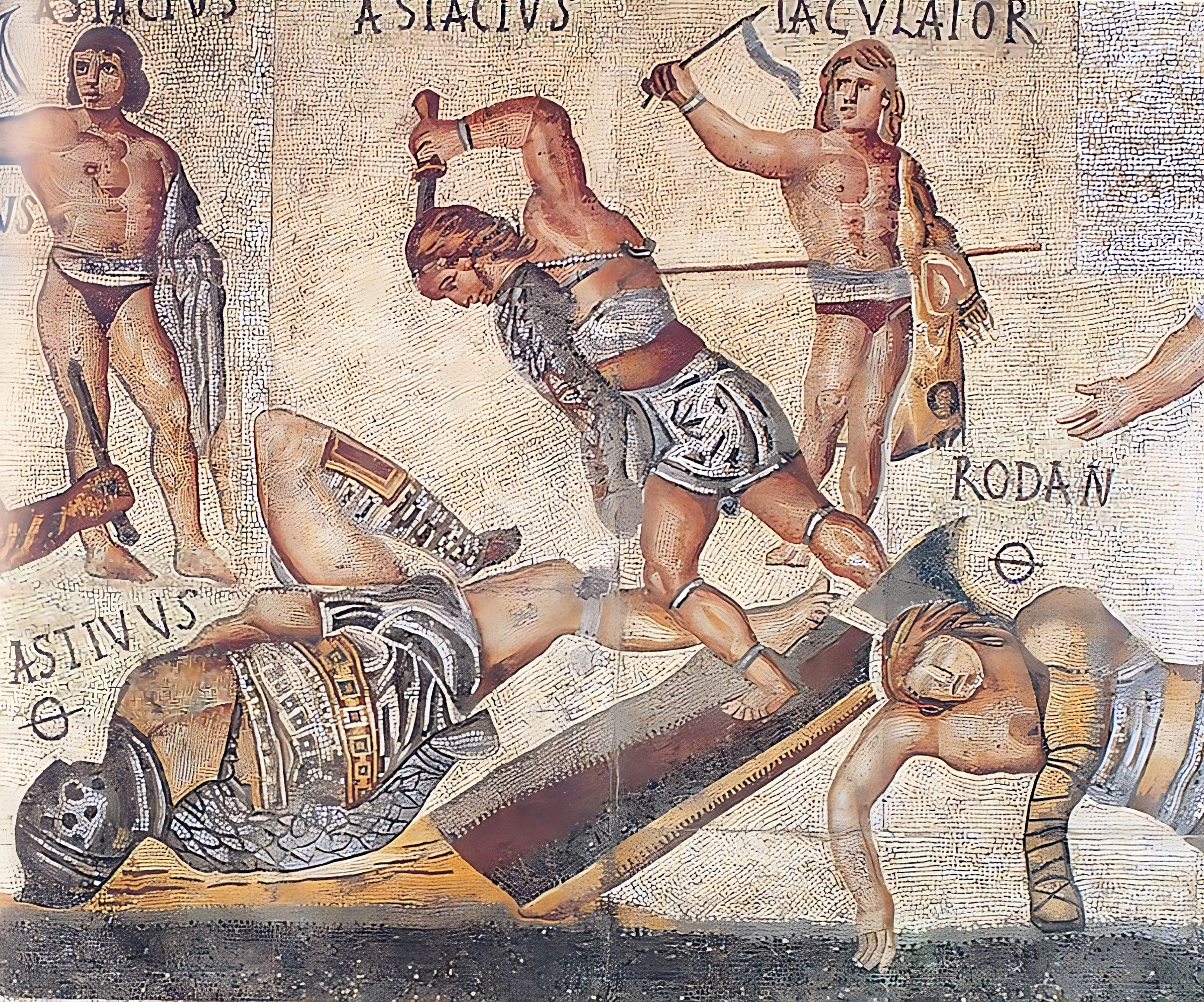
ABOVE: Some gladiators did die. The two gladiators marked with a Ø in this Roman mosaic from Terranova are both dead. The Ø may be intended to represent the Greek letter Θ, which may correspond the give-and-take θάνατος (thánatos), meaning "death" or "corpse"
It is important to emphasize, though, that, even if the gladiators did not fight to the death, fights could yet exist bloody. Obviously, you do not have to kill someone to make him bleed. Non-lethal injuries of all kinds were probably extremely common, certainly far more common than they are for modern sporting events. There are many surviving depictions showing defeated gladiators bleeding. Given that even the all-time medical treatment at the time was generally inadequate, information technology is probable that many gladiators probably died exterior the arena of wounds they had suffered in it.
When fights to the death did occur, it was unremarkably not an actual gladiator who died. The Romans usually sentenced convicted criminals or prisoners of war to dice in the arena for popular entertainment. These were people who were going to exist put to expiry anyways and whose lives were deemed unimportant.
The Romans had all sorts of horrifying and creative ways of putting people to death. Sometimes these untrained criminals and state of war prisoners would be forced to fight each other to the death. Other times they would be sentenced to fight unarmed and without armor against a fully armed, fully armored professional gladiator. Sometimes they would be burned alive. Other times they would be torn apart by lions or other wild animals.
The Roman Stoic philosopher Seneca the Younger (lived c. 4 BC – 65 AD) describes his own cloy at the sight of such an execution in his Moral Letter to Lucilius vii. Here is what Seneca says, as translated by Richard Mott Gummere:
"By chance I attended a mid-day exhibition, expecting some fun, wit, and relaxation, – an exhibition at which men's optics take respite from the slaughter of their fellow-men. But it was quite the reverse. The previous combats were the essence of compassion; just at present all the trifling is put aside and information technology is pure murder. The men have no defensive armour. They are exposed to blows at all points, and no one ever strikes in vain. Many persons adopt this programme to the usual pairs and to the bouts 'by request.' Of course they do; at that place is no helmet or shield to deflect the weapon. What is the need of defensive armour, or of skill? All these mean delaying death. In the forenoon they throw men to the lions and the bears; at apex, they throw them to the spectators. The spectators need that the slayer shall face the homo who is to slay him in his plow; and they always reserve the latest conqueror for another butchering. The outcome of every fight is decease, and the means are fire and sword. This sort of thing goes on while the arena is empty. You lot may antiphon: 'Only he was a highway robber; he killed a man!' And what of information technology? Granted that, as a murderer, he deserved this punishment, what law-breaking accept y'all committed, poor fellow, that you should deserve to sit down and see this bear witness? In the morning they cried 'Kill him! Lash him! Burn him! Why does he meet the sword in and so cowardly a way? Why does he strike so feebly? Why doesn't he die game? Whip him to meet his wounds! Permit them receive accident for blow, with chests bare and exposed to the stroke!' And when the games stop for the intermission, they announce: 'A petty throatcutting in the meantime, then that at that place may yet be something going on!'"
Again, these are non gladiators Seneca is talking nigh here, simply rather criminals and war prisoners sentenced to death in the loonshit. Even so, descriptions such as Seneca's seem to be a large role of the reason why many people accept come to believe that gladiators always fought to the expiry.
The famous phrase "Ave Imperator, morituri te salutant!" (i.e. "Hail Emperor, nosotros who are almost to die salute you!") was not spoken by gladiators, but rather, according to the Roman author Suetonius in his Life of Claudius, by 1 particular grouping of criminals and captives of war who had been sentenced to dice in the arena by the Emperor Claudius in 52 AD. Suetonius is the simply i who mentions the phrase, though, and it was likely only a ane-time occurrence, non a customary greeting. Information technology is also possible that Suetonius may have just made the whole saying upwards, since he has a reputation for not being a very reliable source.

ABOVE: Ave imperator, morituri te salutant, painted in 1859 by the French Academic painter Jean-Léon Gérôme, depicting gladiators greeting the Roman emperor Vitellius
Misconception #ii: When they were non fighting, gladiators were kept locked in filthy cages infested with rodents, were given nada but gruel to eat, and were provided with aught but hard stones to sleep on. If they were injured, they were left to die.
This idea, seemingly ubiquitous amid modernistic portrayals of gladiators, is completely faux. Nosotros admittedly do not know very much about what conditions were like for gladiators on a daily ground, simply all the bear witness we do take, which comes generally from archaeology, indicates that gladiators were actually well-fed, well cared-for, and received adequate medical attention. They could even earn plenty coin to buy their own freedom. Some gladiators who did earn their own freedom still continued to fight, just for the fame and glory.
In fact, in many means, gladiators were much more similar modernistic celebrity athletes than the brutal killing machines they are portrayed as in Hollywood films. The portraits of famous gladiators decorated public spaces. Roman boys oftentimes played with tiny gladiator dolls.

ABOVE: Roman terracotta gladiator dolls dating to the belatedly first century BC
Gladiators could even be sex symbols; for example, a graffito from Pompeii describes one gladiator every bit "decus puellarum, suspirium puellarum" ("the delight of girls, the sighed-for joy of girls"). Gladiator sweat was sold because it was believed to act as an aphrodisiac. Gladiators even endorsed products! The allure of life equally a gladiator was then seductive that the Roman emperor Commodus (ruled 177 – 192 AD) actually fought equally one in the arena (although his opponents ever intentionally let him win).
Above: Detail of a Roman floor mosaic from the town of Zliten in Libya, dating to the around 2d century Advert, depicting diverse kinds of gladiators fighting
Misconception #3: Gladiator fights were nothing but people fighting in the arena in hand-to-mitt combat.
Ironically, while Hollywood is normally known for exaggerating things, when it comes to the sheer spectacle of Roman gladiator fights, they take actually done the exact opposite: they take completely failed to capture merely how insane these fights ofttimes were.
In historical reality, gladiator fights were massive public glasses with so much more simply people fighting in paw-to-hand combat. The Romans were constantly thinking of new and creative means to make the fights exciting to draw in huge crowds. Gladiators wore elaborate and often outlandish costumes that were commonly very loosely based on the actual armor and weapons of various Roman enemies.
There were besides different kinds of gladiators, each of which had its own unique costume, weaponry, and fighting style. The Romans enjoyed having unlike styles of gladiators fight each other to come across who would win. Popular interest in gladiator fights was oftentimes much more well-nigh the dissimilar kinds of weapons and fighting styles than about sheer bloodshed and carnage. Everyone had their favorite kinds of gladiator and they would argue about which ones were ameliorate, much similar how modern sports fans argue near which sports teams are better.
Perchance the nigh utterly bizarre kind of gladiator was the retiarius, who fought blank-chested, with a heavily-armored correct arm simply no other armor any. He fought with a trident and net as his weapons. Retiarii were known for being small, quick, and light on their anxiety. Their lack of armor and unconventional weapons meant that they had to exist highly trained and highly skilled. It is unclear where idea for the retiarius outfit and fighting fashion came from, but, by the middle of the showtime century AD, retiarii had come to boss the arena.
The retiarius was so ascendant in the arena that, from effectually l AD onwards, some other kind of gladiator known every bit a secutor, or "attorney," began to exist specially trained to fight him. The secutor was basically the verbal opposite of a retiarius; while the retiarius merely wore armor on his left arm and had no shield, the secutor was heavily armored all over and had a large rectangular shield he used to protect himself. While the retiarius was quick and low-cal on his feet, the secutor was slower-moving because he was wearing more armor. While retiarii relied on existence highly skilled fighters, secutores relied more than heavily on brute strength.

ABOVE: Scene from the Zliten mosaic showing a wounded retiarius surrendering to a secutor
Things got even more fantastical than only outlandish costumes and fighting styles. Gladiators oftentimes reenacted famous historical battles in the loonshit with very elaborate sets, props, and costumes while professional poets recited a poetic account of the battle. You know those "living history" battle reenactments we have today? Those are basically the modern equivalent of these types of gladiator fights, but on a much smaller calibration.
Gladiators did not just fight in hand-to-mitt gainsay against other gladiators. Some arenas, including the Colosseum, were designed so they could exist filled with water, allowing gladiators to fight naval battles. The tardily first-century AD Roman poet Martial describes in his On the Public Spectacles 24 the astonishment of a greenhorn coming to Rome and seeing a mock naval battle in the Colosseum:
"Whoever you may be, who are hither a lately arrived spectator from distant lands, upon whom for the first fourth dimension has shone the vision of the sacred show,—that the goddess of naval warfare may not deceive you lot with these ships, nor the h2o then like to the waves of the sea,—hither, awhile since, was the dry country. Exercise you lot hesitate to believe it? look on, whilst the waves fatigue the god of war. A short interval, and you will say, 'Here but a while since was the sea.'"
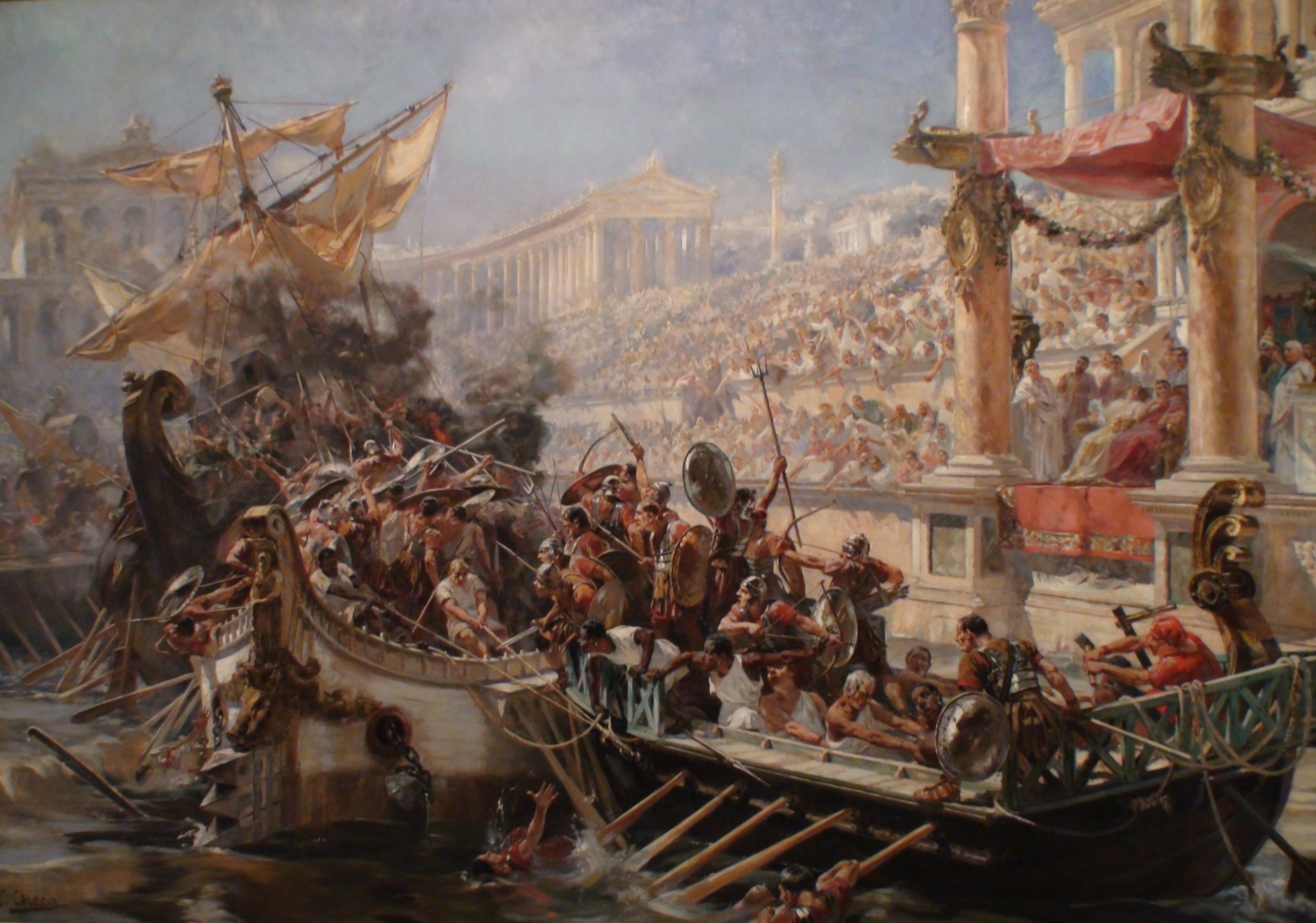
ABOVE: The Naumaquia, painted in 1894 past the Spanish historical painter Ulpiano Checa, depicting his imagining of a staged naval battle in the Roman Colosseum
Fights betwixt homo warriors and wild fauna of all sorts were also extremely popular. Officially, gladiators simply fought other gladiators, so trained fighters who specialized in fighting wild fauna were known as bestiarii.
The more bizarre and exotic the animals were, the more than exciting they were and the more likely they were to draw in crowds. We have mentions and portrayals of bestiarii fighting not only lions, but also elephants, hippopotamuses, crocodiles, hyenas, leopards, tigers, wolves, bears, rhinoceroses, ostriches, chimpanzees, and even on at least one occasion a giraffe. These sorts of exotic animals likewise showcased the might of the Roman Empire.

Higher up: Item from the Zliten mosaic showing bestarii fighting diverse kinds of wild fauna, including bears, lions, deer, wild bulls, horses, and leopards

ABOVE: Particular from the Zliten mosaic showing a bestiarius fighting ostriches

To a higher place: Detail of a Roman floor mosaic from Bad Kreuznach, Frg, depicting a bestiarius slaying a bear

ABOVE: Some other scene from the Bad Kreuznach mosaic showing a bestiarius slaying a leopard
Misconception #4: Everyone approved of gladiatorial games.
Even in artifact, many people actually objected to gladiatorial games, seeing them every bit null more than pointless brutality. (You lot have to remember that, while deaths in the arena were generally not as mutual equally they are portrayed in modern films, they did still happen and, since gladiators always fought with real weapons, non-lethal injuries were very common as well.)
The Roman orator Cicero (lived 106 – 43 BC) condemned gladiator fights in a letter of the alphabet written in around 55 BC to his friend Marcus Marius. Cicero writes:
Why, again, should I suppose you to intendance about missing the athletes, since you disdained the gladiators? in which even Pompey himself confesses that he lost his trouble and his pains. There remain the 2 wild-animate being hunts, lasting five days, magnificent—nobody denies it—and nonetheless, what pleasance tin it be to a human of refinement, when either a weak man is torn by an extremely powerful animal, or a splendid animal is transfixed past a hunting spear? Things which, afterwards all, if worth seeing, you have often seen before; nor did I, who was present at the games, come across anything the least new. The last mean solar day was that of the elephants, on which there was a bully deal of astonishment on the part of the vulgar crowd, but no pleasure whatever. Nay, there was even a certain feeling of compassion aroused by it, and a kind of belief created that that animal has something in common with flesh.
While Cicero certainly had disdain for the games, Seneca the Younger, in the passage I quoted towards the beginning of this commodity, expressed intense, visceral revulsion towards them. Later Christian writers outright deplored them equally encarmine and immoral.
The early Christian writer and theologian Tertullian (lived c. 155 – c. 240 AD), a North African of Berber origin who wrote in Latin, condemned gladiatorial games in the strongest possible terms in Chapter XIX of his treatise On the Spectacles, as translated past Reverend Due south. Thelwall:
"We shall now see how the Scriptures condemn the amphitheatre. If we tin can maintain that it is right to indulge in the fell, and the impious, and the trigger-happy, allow us get at that place. If nosotros are what we are said to be, permit u.s. regale ourselves there with human blood. It is good, no doubt, to have the guilty punished. Who but the criminal himself will deny that? And yet the innocent can observe no pleasure in some other'due south sufferings: he rather mourns that a brother has sinned so heinously every bit to need a punishment and then dreadful. But who is my guarantee that it is ever the guilty who are adjudged to the wild beasts, or to some other doom, and that the guiltless never suffer from the revenge of the judge, or the weakness of the defence, or the pressure of the rack? How much ameliorate, so, is it for me to remain ignorant of the punishment inflicted on the wicked, lest I am obliged to know too of the skillful coming to untimely ends–if I may speak of goodness in the case at all! At whatsoever rate, gladiators non chargeable with law-breaking are offered in sale for the games, that they may go the victims of the public pleasure. Even in the case of those who are judicially condemned to the amphitheatre, what a monstrous thing it is, that, in undergoing their punishment, they, from some less serious malversation, advance to the misdeed of manslayers!"
The later Christian writers Lactantius (lived c. 250 – c. 325), John Chrysostom (lived c. 349 – 407 Ad), and Augustine of Hippo (lived 354 – 430 AD) besides condemned the gladiatorial contests equally heinous and immoral.
Eventually, after Rome converted to Christianity, gladiatorial games were outlawed entirely. In 399 Advertizing, the Emperor Honorius closed the schools for gladiators and, in 404 Advertizement, he banned gladiator fights entirely, bringing an end to the centuries-long history of the games.
Misconception #v: Gladiator games were the almost popular grade of public amusement in aboriginal Rome.
Despite their asymmetric prominence in modern films and television, gladiator fights were actually never the most pop form of public amusement in ancient Rome. For one thing, the Colosseum itself, the largest arena of its kind, could only seat roughly 50,000 people, which means that simply effectually 5 pct of the estimated one million people living in the metropolis of Rome at its height could fifty-fifty fit in it when information technology was completely full.
Additionally, many of the seats in Colosseum were reserved for specific people, such equally the emperor, Senators, Vestal Virgins, and other prominent individuals. These seats were reserved, regardless of whether the people they were reserved for actually came to the show or not, meaning that the bodily number of people able to nourish any given gladiatorial match must have been considerably lower than the number of people who could conceivably fit into the seating area of the Colosseum.
The Circus Maximus, the horse-racing stadium in the city of Rome, could hold more than twice as many people as the Colosseum. The ancient Romans, much like architects today, designed seating areas based on how many people they thought the area would demand to be able to concord. Therefore, the fact that the Circus Maximus could seat twice as many people as the Colosseum would seem to indicate that horse and chariot races were roughly twice as popular as gladiatorial games.
Strangely, though, we see far more depictions of gladiators in modern pop culture than equus caballus races, perhaps because people today find horse and chariot races less exciting than the idea of slaves being forced to fight each other to the decease for popular amusement. The irony is that we and so frequently think of the ancient Romans as being so barbaric, nevertheless we are the ones who have the asymmetric fixation with gladiator fights.

ABOVE: Imaginative painting of what the Circus Maximus might take looked similar at its height from effectually 1638, painted by the Italian painters Viviano Codazzi and Domenico Gargiulo
Misconception #6: A "thumbs-down" from the editor, the authorisation supervising the lucifer, meant a fallen gladiator was supposed to dice and a "thumbs-upwardly" meant he would be allowed to live.
While it is truthful that, during some events, the editor could signal to a gladiator to kill his fallen opponent, the signal to do this was non a "thumbs downwards" gesture. This misconception arises from a mistranslation of the Latin phrase pollice verso, which literally means "with a turned thumb." Scholars debate exactly what this phrase means, only it probably did not mean a "thumbs down." Instead, information technology probably referred to some kind of thumb-to-the-side gesture.
Likewise, the sign for a gladiator to spare his opponent was not a "thumbs upwardly," just rather a closed fist (pollice compresso; "with a compressed thumb"). The but reason why the "thumbs upwards" gesture has become then widely believed to take been the sign used to indicate a gladiator could live is probably because of the gesture's prominence in our own culture today.
Summary
I know I have covered a lot in this post, so here is a quick recap of the main points:
- In the Roman Empire, gladiators did not always, or even usually, fight to the expiry. Gladiators were a major investment for their owners and the supply of gladiators was vastly lower than the demand for gladiator fights. Therefore, measures were taken to attempt to ensure that gladiators, especially popular ones, lasted as long as possible. Some gladiators did dice sometimes and gladiatorial combat was certainly not a bloodless sport, but the massive expiry toll unremarkably portrayed in Hollywood films is greatly exaggerated.
- Gladiators, far from beingness brutally mistreated, were given the best food and medical care available and the more than pop ones were treated by the Roman people like major celebrities.
- Gladiators fights were massive spectacles. Gladiators often wore outrageous costumes and had distinctive fighting styles. They were non always just two people fighting in hand-to-paw gainsay either; there were also naval fights, reenactments of major historical battles, and fights with all kinds of wild animals captured from all over the Old World.
- Not everyone approved of gladiator fights. Many people, especially early Christians, saw gladiator fights as heinous and immoral.
- Gladiatorial games, despite their disproportionate influence in modern popular culture, were never the well-nigh popular form of public entertainment in ancient Rome.
- A "thumbs-down" was not the sign for a gladiator to kill his opponent, nor was a "thumbs-upwards" a sign for him to let him live.

Source: https://talesoftimesforgotten.com/2019/02/04/misconceptions-about-roman-gladiators/
0 Response to "what would a gladiator do to prevent his death"
Post a Comment