Post It Note Window Art Post It Note Window Art War
Featured Image: The Fe Drapery every bit Churchill described it at Fulton lasted forty years. At the time he also considered it to include states of former Yugoslavia, as well equally Austria, which gained full independence past treaty in 1955. (The Economist)
Introduction
Jacob Weaver is a Hillsdale Higher senior and a Churchill Swain, part of the team completing the last Document Volumes of Winston South. Churchill, the official biography. He was ideally positioned to inquiry press, public and official reaction to Churchill's key speech at Fulton in March 1946, commonly held to have rung downward the Cold War. This paper received an "A" from History Professor Dr. Tom Conner, who recommends it to the attention of Churchill Projection readers.
This commodity is replete with references from The Churchill Documents, vol. 22, roofing 1946-51, to exist published around the end of 2018. Among many revelations, the volume will reveal how closely Churchill liaised over his Fulton remarks with Clement Attlee, the opponent who had ousted him in July 1945. This little-known attribute of the speech illustrates not merely Churchill's collegiality, but his efforts to foster unity on strange affairs between Britain'south two dandy rival parties. For a guide to reading on Churchill after World War 2, click here.
Gathering Storms
Winston Southward. Churchill stood at the forefront of world politics throughout the first half of the 20th century. He served in the high office in Britain for well-nigh of twenty years from 1908 to 1929, but found himself out of power throughout the 1930s.1 It was during this latter menstruation that he warned of the rise of Nazism.2 Churchill's predictions were borne out in 1939 with the onset of Earth War II. Eight months later he became prime number minister, heading a coalition government until a few months after the end of the war in Europe. In the days leading up to the victory, Churchill believed he, with the help of America and the Soviet Wedlock, could transform the postwar earth.3 But U.k.'s general election of July 1945 put his party out of power.4
As the postwar world began to take shape, Churchill, as in the 1930s, predicted danger ahead. Initially, his cries vicious on deaf ears. Out of power, he watched as the United states of america' and his country's foreign policy drifted towards what he perceived every bit another disaster—communism'southward ascendancy. Then a letter arrived from President Harry Truman, inviting him to speak at Westminster College in Fulton, Missouri in March 1946. It was an opportunity for Churchill to shape history in one case again. Though what came to be known equally his "Atomic number 26 Curtain Speech" received mixed reactions at the time, today, scholars recognize that it laid the foundation of public opinion needed for the Westward to pursue a vigorous challenge to Soviet hegemony.
When Churchill spoke on five March 1946, Soviet aggression was on the increment. In Moscow a month earlier, Joseph Stalin had predicted an inevitable clash between the communist and capitalist powers.5 Unresolved questions and failed commitments festered at the boundaries of American, British, and Russian spheres of influence. In the Middle Due east, defying Anglo-American protests, Russian federation refused to withdraw its troops from Iran within the agreed period and demanded territory in the north.6 The Soviets also attempted to replace the Turkish government with one friendlier to the USSR, hoping to control access to the Dardanelles.7 This human activity fostered concerns in London, mindful peculiarly of British interests in Greece.8 Russia as well tested the patience of the United States in the Far E, refusing to get out Manchuria despite U.South. opposition.
Climacteric at Fulton
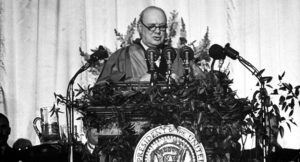
For Churchill, the voice communication at Westminster Higher was the climax of a three-month stay in America, where he rested, recuperated, and thought deeply about the world situation. Though he held no power within the British regime, he remained in affect with it. Moreover, he was highly respected among American officials and the public.ix He spoke several times before Fulton, including a graduation ceremony at University of Miami, just refused annotate about what he intended to say in Missouri.10 This resulted in a high level of speculation, peculiarly since President Truman would be in that location to introduce him.11
American eyes and ears thus focused on the small campus of Westminster—a proper name Churchill joked was "somehow familiar to me….Indeed it was at Westminster that I received a very large part of my education in politics, dialectic, rhetoric, and one or ii other things."12
Quickly, Churchill moved to the threat to world peace. He gave his talk the title "Sinews of Peace" every bit the answer to the threat of war, specifically calling for western solidarity. He began by reminding listeners of the western earth's defense against the "two gaunt marauders, war and tyranny."13 To defend confronting war, he called for a fraternal association of the English language-speaking peoples. This meant a "special relationship between the British Republic and Empire and the United states of America."14 He envisioned a very intimate relationship, calling for unity in defence, even going then far as to propose shared armed services bases and a permanent defense understanding. His next subject was tyranny, and from this passage his voice communication gained its all-time-known name:
From Stettin in the Baltic to Trieste in the Adriatic an iron curtain has descended across the continent. Backside that line lie all the capitals of key and eastern Europe. Warsaw, Berlin, Prague, Vienna, Budapest, Belgrade, Bucharest, and Sofia, all these famous cities and the populations effectually them prevarication in what I must call the Soviet sphere, and all are subject, in one form or another, not simply to Soviet influence but to a very high and in some cases increasing measure of command from Moscow.15
The Soviets did not desire war, he continued. What they wanted was "the fruits of war and the indefinite expansion of their power and doctrines."16 Moreover, the communist threat "plant[d] a growing challenge and peril to Christian civilization."17 The only way to end it was through forceful, unified opposition by the West.
American reaction
In the U.S., Churchill'south depiction of the Soviet threat was broadly accepted. The Wall Street Periodical stated that "behind [Churchill'south] appeal lies a hard core of indisputable facts" and predicted, "the chief effect of Churchill's speech communication will be found not in the immediate adoption of its concrete proposals, but in its education influence. Important facts which have long been known to informed students of international affairs have now been dramatized for pop understanding."18
In London, The Times'south American contributor suggested that Churchill had uttered "the thoughts of the American human being in the street, to say zippo of the executive and legislative representatives of the United states of america Authorities."19 U.S. senators took note. For case, The New York Times reported that, in response to Churchill's oral communication, Senator Burnet Maybank (D.-S.C.) "agreed in the master with Mr. Churchill'due south assertion that Russian federation seemed aptitude on 'indefinite expansion' of its 'power and doctrines.'" twenty Even the left-leaning Chicago Sun, which mainly opposed the speech, agreed with Churchill that "Russian acts of expansion indeed cause great alarm."21
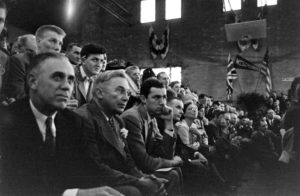
Nevertheless, many American leaders and news outlets criticized Churchill'southward call for what they saw as an Anglo-American alliance. Despite having fought a war with United kingdom, much prejudice still existed against the British Empire.22 Some news outlets and politicians saw Churchill every bit attempting to entangle America in the "heritage of British imperialism."23 The Wall Street Journal and The Times wondered if American opinion was set up for an alliance. The Washington Postal service compared the idea to British reaction to French suggestions for alliance in the appeasement years before the war, when Britain, similar America now, hoped to take a neutral position.24 The Chicago Sun went so far as to suggest that Churchill sought British world domination through American arms.25
The question of alliance reverberated across the American political realm. When the press asked if President Truman'southward presence at Fulton lent American endorsement to Churchill'southward message, Truman told the press that he had no foreknowledge of the spoken communication's content. Secretary of Land James Byrnes denied whatever coordination between the U.S. State Department and the British statesman.26 Truman fifty-fifty instructed Dean Acheson, his Undersecretary of State, not to attend a mail-Fulton reception for Churchill in New York.27 Additionally, many Senators voiced their opposition to American entanglement with British interests away. Senator Owen Brewster (R.-Me.) spoke for many when he stated, "we cannot assume the heritage of British colonial policy." Even Senators who agreed with Churchill'south depictions of Russian aggression, such as Maybank, doubted the feasibility of his plan.28
Reverberations at dwelling house
In contrast to the United States, The New York Times reported that Britons "applauded [the speech] with some reservations." A primary objection in the UK was Churchill's portrayal of communists.29 The Times, for example, criticized the speech as an "assumption of despair" that would pit western capitalists against eastern communists in a zero-sum ideological struggle.30 Both sides, The Times argued, had much to learn from each other. Nevertheless The Times agreed that the Fulton spoken communication recognized the fundamental reality that the Great Powers must reach a settlement.31 The Daily Telegraph and the News Chronicle, though uneasy about Churchill's rhetoric, wrote that his speech might do expert by alerting the world to communist deportment and by sending a strong indicate of opposition to Soviet leaders.32
Many British leaders were too hostile to Churchill's comments on Russian federation. Prime Minister Attlee maintained that neither he nor whatsoever ambassador had approved the spoken communication. Notwithstanding he refused to repudiate it on the grounds that Churchill had spoken only every bit a private citizen. Many Labour Members of Parliament wanted stronger action.33 On March xi, Tom Driberg (Lab.-Maldon) and William Warbey (Lab.-Luton) tabled a motion of censure which bore the signatures of 105 Labour Members.34 Churchill'south speech, it declared, was "calculated to practise injury to good relations between Neat Uk, USA, and the USSR, and [was] inimical to the cause of earth peace."35 Attlee prevented the move from passing, but the hostility within the government remained.
Despite his anti-communist rhetoric, other British politicians and journals embraced Churchill's call for Anglo-American unity. The Times stated that American friendship was an essential element of British foreign policy: "…to near of his fellow countrymen there will seem to exist logic and proficient sense in Mr. Churchill's plan" for a relationship with the Americans.36 The New York Times, reporting on a story in the Daily Telegraph, said "'everybody in his senses' in Great britain was eager to take the closest relations with the United states."37 However, both Times and Telegraph worried that public opinion inside the U.S. was non set for such an intimate relationship, and both affirmed that Uk could not base its foreign policy exclusively on U.South. intervention.38
The Russians respond
Unsurprisingly, the Russians objected both to Churchill's allegations and his telephone call for a closer partnership with America. A New York Times Moscow correspondent reported that the Fulton oral communication caused "hysteria" amongst Russians.39 On March 11th the Soviet authorities responded with a full-folio article in Pravda, entitled "Churchill Rattles the Sabre."40 Churchill was out-of-step with history, it declared, and was inciting nations to war in an endeavor to gain Anglo-American domination. A day later, Izvestia, some other government sponsored newspaper, interviewed Yevgeny Tarle, a Russian historian. "The Soviet Matrimony," Tarle said, "will non submit to threats of military machine preparations or verbal attacks."41 Churchill "was trying to destroy traditional Russian-American friendship and trying to threaten Russia with the latest forms of military machine weapons."42
Stalin soon weighed in. During an interview with Pravda on March 14th, he called Churchill a warmonger and compared his actions and rhetoric to Hitler's before the state of war.43 Churchill'southward charges confronting the Soviets were full of "slander," "discourtesy," and "tactlessness." All the Soviets wanted, said the master of Eastern Europe, was unproblematic prophylactic.44
Fulton in retrospect
Historians still argue over the result of Churchill's Fulton speech. Could the Cold State of war have been avoided without his intervention? John Blum argued that "at least until the fourth dimension of Fulton, the possibility existed of a applied accommodation between the Usa and the Soviet Union."45 But Paul Rahe contends that Churchill infused resolve into an American administration already leaning toward resistance.46 Despite these differences, almost all historians acknowledge that it shaped the rhetoric of the postwar powers, instituting important changes in British and American foreign policy.
Historical scholarship has slowly shifted in its perception of U.South. attitudes in the months preceding Fulton. Though many in Washington were conflicted over what policies the administration should follow, it is now known that George Kennan's "Long Telegram" of February 1946 stood autonomously as a dominant gene.
Kennan, the American Ambassador to the Soviet Matrimony, reported that the Soviets sought to advance the limits of communist power wherever possible.47 Soviet power, "unlike that of Hitlerite Germany, is neither schematic nor adventuristic," he warned. "It does not work past stock-still plans. Information technology does non take unnecessary risks. Impervious to logic or reason, information technology is highly sensitive to logic of forcefulness."48 If the Due west showed resistance against the Soviets, they would recoil.49 A Joint Chiefs of Staff coming together the week before the Fulton oral communication echoed this alert. Soviet aggression and consolidation, the Chiefs concluded, was the unmarried greatest military threat to globe peace.l
What Truman idea
Truman's cabinet had begun discussing resistance to the Soviets well before Churchill's speech. In fact, as Churchill afterward reported to Attlee, the administration had already decided to transport the Soviets a message. They planned respectfully to return the body of a recently deceased Turkish ambassador to Turkey—aboard the USS Missouri.51 A big naval force would accompany the battleship, and establish itself in the Body of water of Marmara.52
While high American opinion favored a policy of resistance, Truman believed he needed to set public opinion within the United States. Consequently, he used Churchill'southward oral communication as an opportunity to warn the earth of Soviet aggression and to help prepare a vision for the future.53 Churchill'south reputation among Americans for his service during World War 2 immune him to convey this non particularly happy bulletin, capturing the attending of an audience eager to hear him.54 And, because he spoke in an unofficial capacity, he could brand public the ideas of Kennan'due south Long Telegram without gainsaying either the American or British governments.55
Though Truman denied it publicly, recent scholarship suggests that his administration had full knowledge of what Churchill would say at Fulton. Some of them even brash Churchill on content. Secretary of Country Byrnes and Chief of Staff Admiral Leahy both read the speech and provided their input, and both overwhelmingly canonical it.56 White House counsel Clark Clifford also read the spoken language and was "securely impressed by [its] sweep and sense of history."57
Well-nigh significantly, Truman himself had read it. Churchill had promised him "that nada should be said past me on this occasion which would crusade you embarrassment. I do not however recall this is likely to happen, every bit nosotros are so much agreed in our general outlook." Truman resisted reading early on drafts for the sake of deniability, but he read the final version on the train to Fulton. He told Churchill it was "admirable and would do nothing simply practiced, though it would make quite a stir."58
Go on the habitation fires burning
Despite his intimate interest with Truman and the American regime, Churchill maintained contact with the Labour government that had defeated him nine months earlier. I of the more interesting aspects of The Churchill Documents Volume 22 is how often, after the 1945 ballot, Churchill coordinated his foreign policy initiatives with Prime number Government minister Attlee.
Attlee's administration was in a precarious position. Like George Kennan, Britain'south ain ambassador to Moscow, Frank Roberts, had written the Labour government, calling for a more forceful policy towards Russia.59 Attlee's cabinet had contemplated it, but Labour's favorable disposition to the USSR and desire for peace limited the government's ability to act. Churchill had cleared his Fulton trip with Attlee and the Labour Foreign Secretary, Ernest Bevin, and told them the line he would have. His words are indicative of the close touch on he was keeping with the Labour government, a tribute both to his collegiality and to his quest for British unanimity in foreign affairs:
I am thinking now about my speech at Fulton, which will be in the same direction as the 1 I made at Harvard two years ago, namely fraternal association in the build-upwards and maintenance of UNO, and intermingling of necessary arrangements for common safety in case of danger, in total loyalty to the Charter. I tried this on both the President and Byrnes, who seemed to like it very well. Byrnes said that he could not object to a special friendship within the Organization, as the United States had already made similar friendships with the South American States. In that location is much fearfulness of Russia here [USA] equally a cause of future trouble and Bevin'south general attitude at UNO has done united states of america a cracking deal of practiced.60
The merely member of Attlee'due south government who actually saw the speech in advance was Lord Halifax, whom Attlee had held over as Ambassador to the U.S. At the Embassy in Washington, Churchill and Halifax went over the draft line past line. Halifax approved, but suggested that Churchill use softer language when referring to the Soviet Spousal relationship.61
Churchill also received British government assist courtesy of the Americans. The White House asked the British Data Service to assistance distribute the Fulton oral communication.62 Though they did not usually publish speeches of not-government officials, they complied, sending accelerate copies to the press and to British embassies abroad.
The lens of Fulton
While historians agree that the Churchill's call for an intimate Anglo-American relationship fell past the wayside, the earth soon accustomed his powerful imagery of the "Iron Drapery." He presented the situation in terms of a diametrically opposed world—liberty versus tyranny, the English language-speaking peoples versus the USSR—and he outlined the long-term policies needed to preserve peace.63 This opposition and the idea of an expansionist Soviet empire set the tone for all future foreign policy decisions in America and Britain.64 Though the public responded with mixed reactions at start, it speedily turned to back up.65 In fact, despite bleak reports from Lord Halifax immediately afterwards the speech, he noted in April a shift in U.S. opinion.66 Writing in October, Truman noted the shift and suggested that Churchill's address "[became] more nearly a prophecy every solar day."67
The lens of Fulton acquired American and British leaders to visualize a stronger policy towards the USSR. Even every bit Churchill spoke, Secretarial assistant of State Byrnes was sending three telegrams to Moscow.68 The beginning asked the Kremlin for the economical agreements between the USSR and its satellite states. The second opposed Russia's financial demands on Communist china. The tertiary objected to violations of the Iran treaty.69 Fifty-fifty without knowledge of coordination betwixt the White House and Churchill, the Wall Street Journal recognized that Churchill'south spoken communication provided greater force to the telegrams: "…it may have been accidental and yet was perhaps not without importance that the mean solar day of Mr. Churchill's speech Mr. Byrnes directed…notes of protestation to Moscow."lxx Several weeks later, when the USS Missouri and its naval escort embarked upon the journey to Turkey, The New York Times credited America's new show of force to Churchill's speech.71 Moreover, every bit the rhetoric became increasingly accepted, information technology laid the foundation of public opinion for the Truman Doctrine of economic and military help to any threatened democratic nation, announced just a twelvemonth later on.72
The rhetoric of Fulton outlived Churchill and shaped the future. The "Fe Drapery" came to define the Cold War carve up until the fall of the Berlin Wall on 9 Nov 1989. Only two years after the speech, Stalin'southward Berlin Occludent sought to "Shut the 'Open Window' in the Iron Curtain."73 Churchill's spoken language influenced an entire generation of politicians on both sides of the Atlantic. President John F. Kennedy reused portions of what became known every bit the "Atomic number 26 Curtain Speech" and granted Churchill honorary citizenship in 1963. President Richard Nixon stated, "It was Churchill's Fe Curtain spoken language…that greatly afflicted my mental attitude to Communism in general and the Soviet Union in particular." Prime number Minister Margaret Thatcher and President Ronald Reagan followed Churchill's program in finally ending the Cold State of war.74 Fifty-fifty today, the printing still hails the plummet of the Soviet Union as the autumn of the Atomic number 26 Pall.75
Endnotes
one Felix Gilbert & David Clay Big, The Terminate of the European Era: 1890 to Present, 6th Edition (New York: W.Westward. Norton, 2009) 53, 279.
ii Ibid., 279.
3 Ibid., 333.
4 Ibid., 351.
5 Martin Gilbert, Winston Southward. Churchill, vol. 8, Never Despair, 1945-1965 (Hillsdale, Mich.: Hillsdale College Press, 2013), 194.
6 R. Crosby Kemper III, "Introduction: The Rhetoric of Civilisation," in R.C. Kemper III, ed., Winston Churchill: Resolution, Defiance, Magnanimity, Goodwill (Columbia, Mo.: Academy of Missouri Printing, 1996), 22.
7 Gilbert, Never Despair, 195.
8 Kemper, "Rhetoric," 21.
9 Lynn Boyd Hinds & Theodore Otto Windt Jr., "Churchill'due south 'Iron Curtain' Divides the Common cold War World," in Derek C. Maus, ed., The Cold War (Farmington Hills, Michigan: Greenhaven Press, 2003), 59. Churchill did remain in impact with Labour Prime Minister Cloudless Attlee, hoping to instill a common resolve between their parties over strange policy. See Martin Gilbert and Larry P. Arnn, eds., The Churchill Documents, vol. 22, 1946-1951 (Hillsdale, Mich.: Hillsdale College Press, forthcoming).
x John Ramsden, "Mr. Churchill Goes to Fulton," in James W. Muller, ed., Churchill's "Atomic number 26 Curtain Speech" Fifty Years Later (Columbia, Mo.: University of Missouri Printing, 1999), 20.
11 "Eager American Audience: Interest in Two Allies," The Times (London), 6 March 1946.
12 Winston S. Churchill, "The Sinews of Peace," voice communication in Fulton, 5 March 1946, in Speech communication Vault. http://speeches-u.s..com/Transcripts/winston_churchill-ironcurtain.html.
13 Ibid.
14 Ibid.
15 Ibid.
sixteen Ibid.
17 Ibid.
18 Ibid.
nineteen "Eager American Audience," The Times (London), six March 1946.
20 "Churchill Speech communication Hailed in London: Call for Anglo-US Tie is Applauded, But Remarks on Russia Bring Division," The New York Times, half dozen March 1946.
21 "Churchill'south Phone call For Earth Domination," Chicago Lord's day, 6 March 1946, in Churchill Documents, vol. 22
22 Chamberlin, William Henry, "Churchill'due south Appeal: Dramatized World Political Trends to the Agreement of All; Some Action by the The states Seems Likely," Wall Street Journal (New York), 8 March, 1946.
23 "Churchill Voice communication Hailed," New York Times, 6 March 1946.
24 "Union Instead of Alliance," Washington Mail, xiii March 1946, in The Churchill Documents, vol. 22.
25 Gilbert, Never Despair, 205; "Britain's Phone call," Chicago Sunday, Churchill later declared that the Sun'southward remarks were "stock communist output." See Churchill Documents, vol. 22.
26 Gilbert, Never Despair, 206; Phillip White, Our Supreme Task: How Winston Churchill'south Iron Drapery Oral communication Divers the Cold War Brotherhood (New York: Public Affairs, 2012), 205.
27 Gilbert, Never Despair, 206.
28 "Churchill Speech Hailed," New York Times, 6 March 1946.
29 Ibid.
30 "Mr. Churchill's Speech," The Times (London), vi March 1946, in The Churchill Documents, vol. 22.
31 Ibid.
32 "Churchill Oral communication Hailed," New York Times, 6 March 1946.
33 Henry B. Ryan, "A New Look at Churchill's 'Iron Mantle' Voice communication," in The Historical Journal, vol. 22, no. four, Cambridge University Press, December 1979, 911.
34 "Leader of Opposition Office: annotation," 11 March 1946 in The Churchill Documents, vol. 22.
35 Ibid.
36 "Mr. Churchill's Oral communication," The Times (London), 6 March 1946.
37 "Churchill Voice communication Hailed," New York Times, vi March 1946.
38 "Churchill Speech communication Hailed," New York Times; "Mr. Churchill'south Spoken language," The Times (London), vi March 1946.Bouillabaisse
39 Kemper, "Rhetoric," 30.
40 "Mr. Churchill and USSR: Moscow Attack on Fulton Speech communication," The Times (London), 12 March 1946.
41 "Moscow Scorns Foreign 'Threats,'" New York Times, 13 March 1946.
42 "Moscow Charges Anti-Soviet Drive: Says Case is being Distorted—Alleges China Asked Russian federation to Stay in Manchuria," New York Times, eleven March 1946.
43 "Joseph Stalin: interview," fourteen March 1946, in The Churchill Documents, vol. 22.
44 Churchill stated that Stalin's charges were "flattering," since Hitler had attacked him in the very same fashion. See Gilbert, Never Despair, 213.
45 Hinds & Windt, "Churchill's 'Iron Mantle,'" 57.
46 Paul A. Rahe, "The Start of the Cold State of war," in Churchill'south "Iron Curtain Speech" Fifty Years Afterwards, 49.
47 Ibid., 63.
48 Ibid.
49 Ibid.
50 Kemper, "Rhetoric," 26.
51 Gilbert, Never Despair, 219.
52 Truman shared these plans with Churchill on the railroad train to Fulton. Run into Gilbert, Never Despair, 208.
53 Rahe, "The Beginning," 64.
54 Ibid., 50.
55 Hinds & Windt, "Churchill's 'Fe Curtain,'" 59.
56 White, Our Supreme Task, 152.
57 Kemper "Rhetoric," 27; White, Our Supreme Task, 156.
58 Gilbert, Never Despair, 197; White, Our Supreme Task, 156; WSC to President Truman, 29 November 1945, in the Churchill Documents, vol. 22.
59 Ramsden, "Mr. Churchill Goes to Fulton," 30.
sixty Ibid., 26; WSC to Attlee and Bevin, 17 February 1945, in The Churchill Documents, vol. 22.
61 White, Our Supreme Task, 142.
62 Ryan, "A New Expect," in The Historical Journal, Dec 1979, 908-10.
63 Hinds & Windt, "Churchill'due south 'Iron Drapery,'" 57, 60; Gilbert, Never Despair, 217.
64 Hinds & Windt, "Churchill'due south 'Iron Curtain,'" 63.
65 Ramsden, "Mr. Churchill Goes to Fulton," 44.
66 Ibid., 45.
67 Ibid.
68 White, Our Supreme Task, 205.
69 White, Our Supreme Task, 205; Kemper. "Rhetoric," 27; WSC to Attlee, 7 April 1946, in The Churchill Documents, vol. 22.
70 Chamberlin, "Churchill'southward Entreatment."
71 Gilbert, Never Despair, 219.
72 WSC to Clement Attlee and Ernest Bevin, seven March 1946, in The Churchill Documents, vol. 22; Hinds & Windt, "Churchill's 'Iron Curtain,'" 61.
73 William Henry Chamberlin, "Berlin Blockade: Russian federation Hopes to Shut the 'Open Window' in the Iron Mantle, But Volition Avoid Armed Clash with US," New York Times, vi April 1948.
74 White, Our Supreme Task, 219-twenty.
75 Jonathan Mann, "How the Iron Drapery Collapsed," on CNN, iii January 2014.
0 Response to "Post It Note Window Art Post It Note Window Art War"
Post a Comment